How Much Does a Tub-to-Shower Conversion Cost in Maryland? (2026)
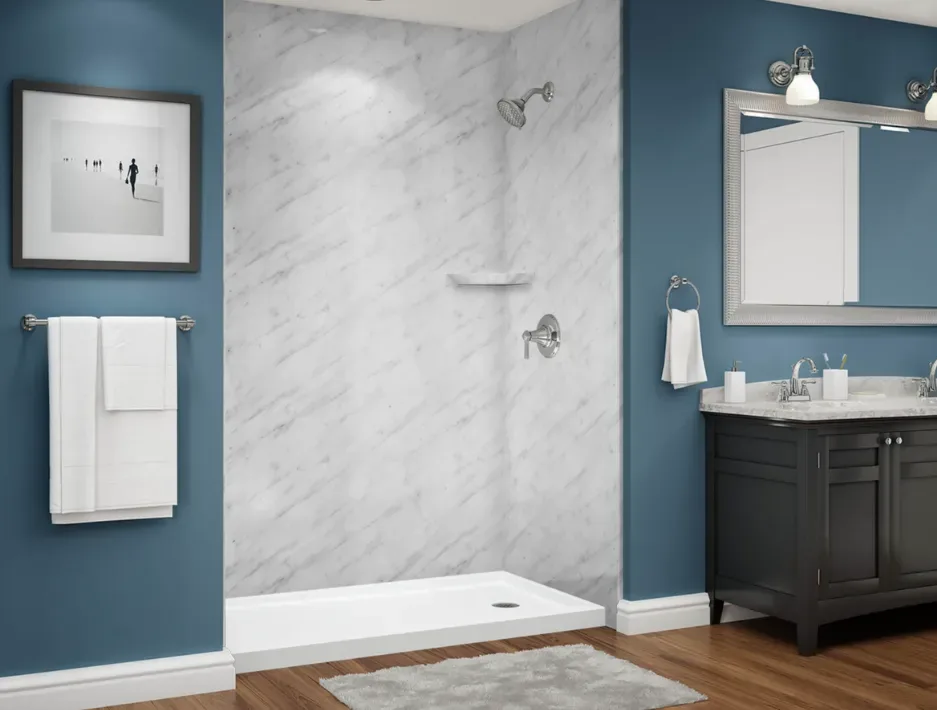
“How much is this going to cost?” is the first question almost every Maryland homeowner asks about a tub-to-shower conversion — and the honest answer is that it depends on your bathroom. This guide explains what actually moves the number so you can walk into a quote knowing what you’re looking at.
The short version
A tub-to-shower conversion falls into one of two very different price tiers:
- An acrylic conversion — removing the tub and installing a pre-fitted, grout-free acrylic base and wall surround. This is a defined-scope project with predictable pricing.
- A full tile remodel — building a custom tiled shower from a mud pan up, often with new plumbing, a bench framed on site, and a linear drain. This is a much larger job, priced accordingly, and takes weeks rather than days.
National and regional remodeling cost guides put tub-to-shower conversions across a wide band because they lump those two approaches together. Your exact figure comes from an in-home measurement.
The six things that change the price
1. The size of the new shower
Keeping the existing tub footprint (typically 60 × 30 inches) is the baseline. Making the shower larger — by taking in an adjacent closet or a second unused fixture — adds material and labor.
2. Wall panel finish
Smooth acrylic panels are the standard. Tile-look and stone-look patterns cost a little more. All of them are grout-free, so none of them need re-sealing.
3. The glass
From least to most expensive: a curtain rod, a framed sliding door, a semi-frameless door, a frameless enclosure. In a small bathroom a framed door often makes more sense than frameless regardless of budget.
4. Accessibility features
A built-in bench, structurally anchored grab bars, a hand-held wand on a slide bar, and a low or zero-threshold base each add cost. If aging in place is the goal, see our accessible bathrooms page — these are worth building in now rather than retrofitting later.
5. What’s behind the wall
This is the variable people forget. Once the tub is out we can see the framing, subfloor and supply lines. In an older Maryland home — a Baltimore rowhome, an Ellicott City colonial, a Silver Spring bungalow — it’s common to find a soft subfloor, a corroded valve, or galvanized pipe that should be updated while the wall is open. A reputable contractor shows you what they find and quotes any extra work before doing it.
6. Fixtures and hardware
Shower head, valve trim, and hardware finish (brushed nickel, matte black, chrome) are a smaller line item, but a rain head plus a hand-held plus a body spray adds up.
Acrylic conversion vs. full tile remodel: which is right?
| Acrylic conversion | Full tile remodel | |
|---|---|---|
| Relative cost | Lower | Higher |
| Timeline | Days | Weeks |
| Ongoing maintenance | Wipe-down; no grout | Re-seal grout; watch for cracked grout lines |
| Customization | Wide within a system | Essentially unlimited |
| Best for | A clean, low-maintenance, durable result without a long disruption | A fully bespoke design and budget to match |
Financing
Most homeowners don’t pay for a conversion out of pocket. We work with third-party lending partners on payment plans, including promotional 0% interest options (subject to credit approval). Details are on the financing page, and your consultant goes over what you qualify for once you have an exact quote.
How to get a real number
Every honest quote for a tub-to-shower conversion starts with an in-home visit: exact digital measurements, a look at the plumbing, and a written price that’s locked in for 12 months with no hidden fees. Transform Bath Solutions serves Columbia and Central Maryland from our base in Howard County.